

Sometimes the old recipes work beautifully. Other times, they need a little translation. And sometimes you make one, taste it, and say to yourself (or your husband, or your cat), “Well. That’s interesting.” Fish Sauce Mère falls into the third category.
I found it in 1933’s Gourmet’s Guide to New Orleans, one of the vintage cookbooks in my Cooking the Past Forward collection, while I was looking for sauces to serve with our inaugural meal from a new countertop fryer. Our menu was fried oysters, hush puppies and something crisp and fresh on the side, and I decided that three sauces sounded about right. Plus, it’s fun to try a bunch of things when I’m in Test Kitchen Mode.

Two of the three sauces were familiar territory: my mother’s Easy Creole Mustard Sauce, and my own Glover Gardens Aioli, a dill variation of that delicious glossy, garlicky wonderment. The third was not familiar at all.
Fish Sauce Mère, contributed to Gourmet’s Guide to New Orleans by Mrs. Jeanne Castellanos, called for six hard-boiled eggs, dry mustard, a cup and a half of mayonnaise, six minced shallots, a quarter of a “small jar of capers,” garlic, Tabasco and horseradish. The yolks were mashed with mustard and stirred into the mayonnaise; the remaining ingredients were added, followed at the end by the chopped egg whites.
Then came the entire serving instruction: “Serve. This is excellent with any cold fish or with shrimp.”
That was it. No yield. No indication of how finely to chop the egg whites. No explanation of what size “small jar” of capers the cook should use. No suggestion of what kind of cold fish. No indication of the occasion, or how many people all that sauce was meant to feed.
The amounts were staggering. Six eggs! Six shallots! A cup and a half of mayonnaise!
I made one-third of the recipe, and even that produced what seemed like an enormous amount, close to two cups.

This sauce had questions, and questions with their answers are a big part of the Cooking the Past Forward project, which is my ongoing exploration of vintage and community cookbooks, the stories and knowledge they preserve, and what they can teach us in the kitchen today. I’ll follow the clues, ask questions, cook what calls to me and thoughtfully adapt when it makes sense, always trying to understand what mattered about the original. The goal isn’t simply to recreate the past, but to carry its best qualities forward to today’s tables.
The Fish Sauce Mère Recipe Assumed I Knew Things
One of the things I said I wanted to look for in Cooking the Past Forward was recipes whose instructions assumed a shared level of culinary knowledge.
Fish Sauce Mère is a very good example. The recipe tells the cook to add “chopped egg whites,” although it never actually says to chop them. More importantly, it doesn’t say how finely. I chopped mine, but not finely enough, as it turned out. The pieces of firm egg white were very noticeable in the creamy sauce, and the texture wandered uncomfortably close to egg salad.

That isn’t necessarily a flaw in the recipe. It may simply be knowledge that the original cook and reader shared, what my former knowledge-management life taught me to call “tribal knowledge.”
The same is true of the capers: “¼ small jar” was apparently enough information at the time. A cook knew what a small jar looked like, just as they presumably knew how finely chopped egg whites ought to be.
Modern recipes tend to spell out much more. We give cup measurements, weights, yields, serving sizes and visual cues. Vintage recipes often remind us how much culinary information once lived somewhere other than the printed page: in the mind and experience of the cook, in casual conversations in the kitchen, and in knowledge gained by watching mothers and grandmothers work their magic.
Then There Was the Quantity
The scale of this recipe fascinated me almost as much as the sauce itself.

Based on my experience scaling it down, the full recipe may have produced five or six cups of sauce. At a generous quarter cup per person, that’s enough for roughly twenty people. Served more sparingly as an accompaniment to cold fish or shrimp, it could go considerably farther.
That made me wonder: what was this sauce for? A luncheon? A buffet? A large family gathering? A restaurant service? The recipe doesn’t tell us.
But then I learned more about Mrs. Jeanne Castellanos, who contributed it.
Mrs. Castellanos Was Not Just Any Contributor
Jeanne Castellanos was associated with Patio Royal, an elegant Royal Street establishment that opened in the French Quarter in 1921. Contemporary accounts describe Patio Royal as a popular setting for luncheon parties, dinner dances and Sunday-night supper dances; later histories add debutante gatherings, Carnival festivities and other society events. Here’s its entry from the 1938 New Orleans City Guide.

There is another wonderful layer to this story. Patio Royal occupied 417 Royal Street, a French Quarter building dating to about 1795 with a history almost as colorful as the city itself. Among its many lives, the building had been the headquarters of the Bank of Louisiana, the home of celebrated nineteenth-century chess master Paul Morphy and, at various times, a boarding house, bookstore, antiques shop and brothel.

Patio Royal moved into the building in 1921 and remained there for roughly three decades. Then another very familiar New Orleans restaurant took over the address in the mid-1950s: Brennan’s. The pink building at 417 Royal is still home to Brennan’s today.

I love the continuity of place. The rooms where Jeanne Castellanos helped create one generation’s New Orleans dining and social life became the home of another restaurant that would become part of the city’s culinary identity, now celebrating its 80th year in business.
Learning about Patio Royal made those six eggs and six shallots look a little different. I can’t say for sure that the Fish Sauce Mère recipe contributed by Mrs. Castellanos was a Patio Royal recipe because I can’t find anything online about the restaurant’s menu. The evidence doesn’t tell us whether she served it professionally, at home or both, but the scale no longer seems quite so mysterious. This was a woman accustomed to entertaining, feeding groups and operating within a restaurant and social world where serving seafood to a crowd would hardly have been unusual.
One of the questions behind my project is how food moved between restaurants and home kitchens, and with this recipe, we may be seeing exactly that kind of porous boundary.
Another Question: Was Fish Sauce Mère Really Sauce Gribiche?
My next rabbit hole was the provenance of the recipe. The ingredient list immediately suggested the classical French sauce gribiche: hard-boiled eggs, mustard, capers and a cold preparation for fish.
And there is definitely a resemblance. In Auguste Escoffier’s Le Guide Culinaire, first published in 1903, gribiche is built by mashing hard-boiled egg yolks with mustard, then working in oil and vinegar to form an emulsion. Capers, cornichons and herbs are added afterward, along with some of the cooked egg whites. Gribiche was among the cold sauces associated with cold fish and other cold foods.
But there’s a particularly interesting difference in the eggs. Escoffier’s recipe uses six cooked yolks but only three of the whites. Fish Sauce Mère puts the whites from all six eggs back into the finished sauce. After actually eating the sauce, that detail matters to me a great deal more than it would have if I had merely read the recipe. All that firm egg white contributes substantially to the texture, but not necessarily in a good way by today’s standards.
Fish Sauce Mère does some of the same things as gribiche. It begins with hard-cooked yolks and mustard. It contains capers. The whites go back into the finished sauce. It is served cold with seafood.
But it is not classical gribiche. Instead of making an emulsion from the cooked yolks, oil and vinegar, Mrs. Castellanos starts with prepared mayonnaise. Her version adds shallots, horseradish, Tabasco and garlic. It leaves out the cornichons and fresh herbs typical of classical gribiche, and there is no added vinegar or lemon juice.
So I wouldn’t call Fish Sauce Mère a renamed gribiche. I would call it a relative, maybe a very New Orleans relative.

Here’s what might be a clue to the name: in his discussion of cold sauces, Escoffier referred to mayonnaise as a sauce mère, a “mother sauce,” because so many other cold sauces were derived from it. Fish Sauce Mère is itself built on mayonnaise. I can’t establish that this explains Mrs. Castellanos’s name for the recipe, but as clues go, it’s an intriguing one.
Another interesting thing to note is that I haven’t found another sauce called Fish Sauce Mère. That doesn’t prove Mrs. Castellanos invented it, but so far the name appears to be unusual. Perhaps it was her own name for a familiar type of cold seafood sauce, or perhaps it belonged to a much smaller culinary circle than gribiche or rémoulade. For now, the name and where it came from are unanswered questions rather than conclusions. And I don’t need to have definitive answers for all the questions to have learned from the experience.
If you’re interested in joining me down the gribiche rabbit hole, I found a lively modern look at its history in Gribiche: The Sauce Escoffier Got Wrong.
New Orleans Was Already Playing with This Family of Sauces
That became even clearer when I looked at an earlier New Orleans source. The Picayune’s Creole Cook Book, first published in 1901, contains a rémoulade made with hard-boiled egg yolks, mustard, vinegar and oil, with the cooked whites crumbled for garnish. It also contains a green rémoulade made in essentially the same way, colored with parsley or spinach.
In other words, a sauce that looks gribiche-like through modern eyes was already being called rémoulade in New Orleans decades before Fish Sauce Mère appeared.
That matters because it warns against getting too rigid about names. These recipes show techniques being adapted, renamed and recombined in New Orleans kitchens, which is another reason not to get too rigid about the labels.
The individual recipes tell stories. The corpus reveals patterns.
And here, the pattern shows that Fish Sauce Mère belongs in an extended family of cold, piquant seafood sauces built around eggs, oil or mayonnaise, mustard, capers, herbs, pickles, shallots and acidity.
The proportions and names changed. The idea endured. This particular recipe, maybe not.
Cold Fish with Cold Sauce Was a Thing
This may have been the biggest revelation for me. When I first read “excellent with any cold fish or with shrimp,” I wondered what kind of cold fish people were eating. Quite a lot of it, apparently.
A nineteenth-century guide to New Orleans described the elaborate fish dinners served at the resorts near Lake Pontchartrain. Fish appeared boiled, stewed, baked, fried and broiled, but there was also a category described as “Salad, or Mayonnaise,” meaning cold fish served with cold sauces. Shrimp was singled out as particularly good served this way. The same menus included red snapper, redfish, sheepshead, trout, pompano and many other local fish.
Suddenly Fish Sauce Mère seemed less odd. It belonged to a recognizable way of eating seafood that has faded from popularity.
That also connects beautifully with another recipe in Gourmet’s Guide to New Orleans that had already caught my attention: Boiled Fish. Its instructions are sparse by modern standards, and it casually suggests serving the fish hot with egg sauce and capers, or cold with mayonnaise. I was so amused and intrigued by the brevity of this recipe that I included it in my introductory post about Cooking the Past Forward.


The cookbook seems to assume that the reader already understands a whole vocabulary of boiled fish, cold fish and accompanying sauces.
I didn’t. I still don’t. And that’s exactly why I’m doing this project: to experiment, to learn and to share what I learn. And to selectively add to the Glover Gardens repertoire of dishes that deserve a place on our table.
Why Didn’t I Like It More?
Sometimes the experiment doesn’t result in an Instagrammable success. Unearthing the history (or at least, the partial history) can explain a recipe without anyone falling in love with it, and this was the case with Fish Sauce Mère. It was perfectly edible. It simply wasn’t something I found myself reaching for beside the fried oysters and hush puppies.

Part of the problem was texture. The chopped whites from hard-boiled eggs remained quite distinct in the mayonnaise base. Remember my egg salad comparison? Honestly, I don’t love gribiche for the same reason: call me biased, but I like my egg salad on a sandwich or a cracker, not in a sauce.
Another part of my problem with it was richness, which I might even extend to call gloppiness. I missed acid and freshness.
Classical gribiche gets acidity from vinegar. The 1901 New Orleans rémoulade also contains vinegar. Even the Picayune’s mayonnaise itself includes lemon juice and vinegar. But the Fish Sauce Mère recipe I made relies largely on the acidity that’s already in its mayonnaise and capers.
My modern palate wanted lemon, and something fresh and green.
If I were going to make it again, I would chop the egg whites much more finely, use perhaps half as many of them, add lemon juice and probably add an herb. Tarragon would pull it toward its French cousins. Dill would be wonderful with seafood. Parsley would be a gentle complement.
And I would make much less of it. Much, much less.
But Would I Make It Again?
I would not make this recipe again. The purpose of Cooking the Past Forward isn’t to take every vintage recipe and polish it until it becomes something I want to publish as a new Glover Gardens recipe. Some deserve resurrection, some deserve adaptation, and some deserve to remain exactly where they are. Others deserve to be cooked once because the act of cooking them teaches us something we could never learn merely by reading.
Fish Sauce Mère did that. It taught me to pay attention to scale, reminded me that texture can depend on instructions a recipe never bothers to give, and introduced me to a once-familiar way of serving cold fish. It led from an old New Orleans cookbook recipe to classical French gribiche, then backward into early New Orleans rémoulade. It connected a named contributor to Patio Royal and the social life of the French Quarter, then led me all the way to the history of the building that later became Brennan’s.
If only those walls could talk, baby!
And it demonstrated something I suspect I will encounter again and again in these old books:
Sometimes the recipe name is less revealing than the ingredients.
If I had searched only for “gribiche,” I might have concluded that this kind of sauce was missing from New Orleans cooking. It wasn’t missing. It was hiding under other names.
The Sauce I Didn’t Love Was Still Worth Making

When I started Cooking the Past Forward, I said I wanted to ask which old dishes had disappeared, which were so familiar that cooks barely bothered to explain them, which sounded strange to modern ears, which deserved another look and what their best qualities might still offer today’s kitchen.
Fish Sauce Mère managed to answer many of those questions at once.
I still don’t particularly want a large bowl of it. But now I understand it, and I’ve learned from it.
And there’s one more lesson that points in the other direction, from the past toward the recipes I’m writing now. If I want my own recipes to stand the test of time, I need to be very, very explicit.
I don’t want cooks in 40 years wondering what size to chop the egg whites!
One More Thing the Cookbook Tells Us
There is one more piece of evidence in this cookbook that has nothing to do with Fish Sauce Mère. The earliest cover uses a racist caricature that is difficult to look at today. I am including it because the cookbook itself is a primary source, and its imagery is part of the historical record, too. Later editions used very different covers, which is itself evidence of changing expectations about how New Orleans, its food and its people should be represented.


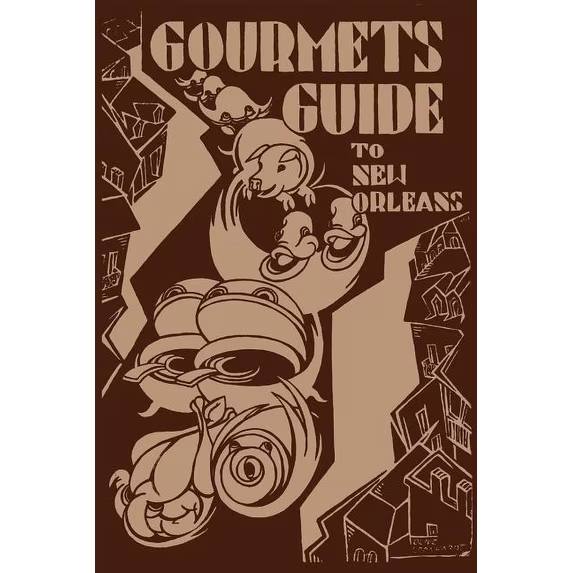
Three editions of Gourmet’s Guide to New Orleans. The changing covers are another reminder that the recipes are not the only historical evidence these old cookbooks preserve.
I don’t intend to look away from those stereotypes or exclusions simply because they are uncomfortable. If Cooking the Past Forward is going to take these books seriously as historical sources, then the prejudices and omissions they preserve are evidence, too. That means paying attention not only to what these cookbooks preserve, but also to whom they stereotype, omit or leave unnamed.
©️ 2026, Glover Gardens


That sounds yummy. (again!)
I have been to “Nawr-leens” only once, half a century ago…
I remember we ate very well…
You should go back! It’s such an amazing town that you could at the same time feel like, wow, this is the place I remembered, and wow, there’s so much more here. It is constantly reinventing itself, but as a quilt adding one more square rather than something entirely new. And yes, you would still eat VERY well.