
Learning by Doing at KMWorld
What do storytelling, art, gumbo and a five-minute appetizer have in common? At KMWorld 2026, they’re all hands-on ways to explore how people share, apply and build knowledge together.
A multifaceted blog for multifaceted people


What do storytelling, art, gumbo and a five-minute appetizer have in common? At KMWorld 2026, they’re all hands-on ways to explore how people share, apply and build knowledge together.

What happens when you study a whole family of vintage Shrimp Creole recipes before making your own? This Cooking the Past Forward version brings together the patterns, surprises and personalities I found in old Gulf Coast and New Orleans cookbooks, then carries them into the Glover Gardens kitchen.

The dVerse prompt for today was all about the moon, a hunter’s moon.

We were instructed to write a haibun (prose followed by haiku) about it. I tried but couldn’t get prose to work, so it’s an unstructured poem, and then the haiku.
you step outside
intrigued by the moon
darkness abounds
but for the glow
of this amazing
radiant orb
(hunter’s moon)
it sings, silently,
a jazzy serenade
siren song calling
knowing you can’t resist
staring, you acknowledge
that the moon
is your master
(mistress?)
the boss of you
for these few
moments
of silence
(reflection)
and oneness
with the
universe
and you know
(having stepped outside)
that somehow…
you
will
never
be
the same
the moon
is your master
(mistress?)
the boss of you
and somehow…
you
will
never
be…
the same
♦ UNFORGETTABLE ♦

The moon called to me, to write this poem, and then the haiku that follows.
jazzy hunter’s moon
glowing orb demands notice
(unforgettable)
dVerse is an amazing group of poets – go check it out! The other responses to the prompt can be found here.

All photos by Glover Gardens.
All inspiration courtesy of dVerse Poets Pub.
© 2026, Glover Gardens

A Texas-sized turkey patty melt with Zippy Sicilian-seasoned turkey, melted cheese, sautéed red onions, avocado and arugula on thick toasted brioche, with condiments left up to the diner.

Grilled oysters are easier to make at home than you might think. This Glover Gardens version uses a lemony, garlicky Parmesan butter, real oyster shells and a few hard-earned tricks for grilling and serving them at their bubbling-hot best.

Don’t you love that feeling when you’ve finally finished something you’ve been procrastinating about? That frisson of pleasure every time you encounter the results and think, “Yeah, I did that. About time, and isn’t it fab!” That’s the way I feel after my Early Fall Plants-in-Pots-on-the-Patio Project.

In late summer and early fall, my patio plants sometimes get a bit woebegone and bedraggled, and need pinching, plumping, replanting or repotting. It’s still very, very hot even when autumn officially begins, and I had to cajole myself last weekend to do what needed to be done. It took a LOT of prompting:
“You’ll be glad when you see the results.”
“It’ll only be a few hours.”
“You’ll burn some calories.”
“You can jump in the pool if you get overheated.”
“Think how much better your poolside food pictures will look.”
Somehow, I ginned up the energy to get started, and spent about 3 hours tending the patio plants. All were inspected for health, and where necessary, pruned. Some were repotted, some were downgraded to a less visible spot, and some were promoted.

I rearranged everything to put the current all-stars in the most visible places, and to optimize the view.
What I didn’t do was stress about having “fall colors”. I learned this lesson a few years ago.
The Grill-Meister was going to Home Depot on a weekend errand and asked me if I wanted to add anything to his list. I said, “A couple of small blooming plants would be great.” In my head, that meant he’d bring back something in fall colors.
No.
I got a gorgeous pink hibiscus and a blue salvia, both with beautiful blooms. I said “thank you,” of course, but was momentarily disappointed because, as I said, I was expecting fall plants. But I’d never actually said that, so how could he have known what I had in mind? And on reflection, I realized I was being a Plant Bigot.
Here in Southeast Texas, we have about eight months of summer, from April through November. Or at least, we have what would be considered summer weather in many other places, the kind of weather blooming plants love. Pink and blue ARE fall colors here, because fall is only on the calendar, not in the air. We get a break from the blistering heat, but the summer-blooming plants keep delivering on their promise of blooms until late November. Check out this post to that effect from 2015.
So why did I feel the need for only orange, red and yellow “fall colors” in the plants The Grill-Meister picked up for me? It was an arbitrary seasonal color bias that doesn’t fit our geographic location, and I’m OVER IT.
If it blooms here in the fall, it’s a Fall Color. Period.
So last weekend’s work to spruce up the patio plants resulted in a summer-looking fall tableau. I’m in love with it.

There’s a hummingbird below on the feeder in the top left quadrant, if you look closely.

The herbs in their pots are still going great guns, including the basil.

And just as I asserted when I was doing the positive self-talk to get myself going on the 3 hours of sweaty plant-pot work, the backdrop did prove to be very nice for food pics. That’s a dish The Grill-Meister made using a recipe in the August issue of Food & Wine magazine, their Chile Relleno Dip. We enjoyed it on the patio later on the same day.

We thought the recipe had promise, but didn’t fully deliver… so we’ll be reworking it to share with you. They put brown sugar in the topping, and that was just plain weird… it didn’t seem chile relleno-ish and the sweetness was unwelcome. The recipe has good bones, though, so stay tuned!
Enjoy the fall colors, wherever you are.
©️ 2026, Glover Gardens

A vintage New Orleans sauce sent me down a rabbit hole through sauce gribiche, cold fish, Patio Royal, Brennan’s and the assumptions old recipes made about the cooks reading them. I didn’t love Fish Sauce Mère, but I learned a great deal from making it.

Easy Creole mustard sauce is both piquant and creamy, with the unmistakable twang of mustard and horseradish pepped up with a healthy dose of cayenne, and a dollop of mayonnaise to smooth it all out.


I like walking before dawn, when the neighborhood is quiet and the weekday hasn’t quite started humming yet. Yesterday’s walk was quieter than usual. Darker, too, with no moonlight. And considerably more eventful.
This little true story became a poem because of the latest prompt from the dVerse Poets Pub. De Jackson, aka WhimsyGizmo, challenged participants to write a quadrille, exactly 44 words, using some form of the word “hum.” I counted hyphenated words as a single word instead of two.
lacking sidewalks

I power-walk
in the street
before dawn,
avoiding weekday
traffic’s hum

in darkness
I kick something hard

— dead armadillo!! —

blood on my shoe??

overzealous sprinkler
nails me

half-mile later:

— another dead armadillo!! —

questions:

why water streets?

why not lock up your armadillos?
It was so much fun to write this poem! The “hum” part was easy. Before dawn, I’m deliberately out there before the weekday hum and thrum really get going, when school buses and commuters rush toward their busy days and make life treacherous for power-walkers in the street.

The armadillos and the sprinklers provided great material for the poem. Kicking a dead armadillo was a bit of a shock, though, and walking with wet feet because the sprinklers took their jobs too seriously was not altogether pleasant. When I saw the second dead creature in the street, I knew I had to write about this wacky, unpredictable pre-dawn experience. Seeing both poor creatures lying in the road also made me glad I wear a light on my wrist when I walk before daylight!
These remain my persistent questions:
Not familiar with the quadrille format? It was created by the dVerse community. The rules are simple: it must be exactly 44 words long and include some form of the prompt word.
If you love poetry and want to read more of the humdinger quadrilles, hop on over to dVerse’s Mr. Linky and check them out. Or join us! The dVerse Poets Pub is open to everyone.
©️ 2026, Glover Gardens

Smoked duck, homemade duck stock and a roux made partly with rendered duck fat turned our usual sausage gumbo into something darker, smokier and even more deeply flavored. Day 1 was wonderful; Day 2 was phenomenal.

Smoked duck gets a second act in this rich, company-worthy dinner. We crisped the skin on cold smoked duck breast, paired it with a simple orange-garlic sauce and served it alongside creamy risotto.

Sometimes a recipe begins with a cookbook. Sometimes it starts at the farmers’ market. This one for smoked whole ducks started in the car.
The Grill-Meister and I were driving home from Gumbo Cove, doing what we often do on a road trip: talking about food, new things we want to try, different approaches to our go-to recipes, what we might serve for an upcoming party. Somehow the conversation turned to gumbo.
He loves smoking meats, and we both love gumbo. Why not smoke whole ducks and use them in our gumbo instead of our usual (not-smoked) chicken? We could probably find some other things to do with some of the meat, which we were hoping would be delicious. (The Grill-Meister’s efforts with the smoker NEVER disappoint.)
It sounded like a very good plan. It turned out to be even better than we thought. Two smoked ducks eventually gave us a wonderful dinner of crisped duck breast, duck flatbreads the following evening, a deeply flavored homemade stock and, finally, one of the best gumbos I’ve ever made.
There was even another bonus: duck fat. Lots of gorgeous duck fat. My friends, there is a DIVINE amount of flavor in duck fat.
Nothing about this project went to waste.
Finding the ducks required a little field trip. Our usual grocery store was out of the whole ducks it carries, so we headed to an Asian market about ten miles up the road and came home with two beautiful, substantial frozen whole ducks.
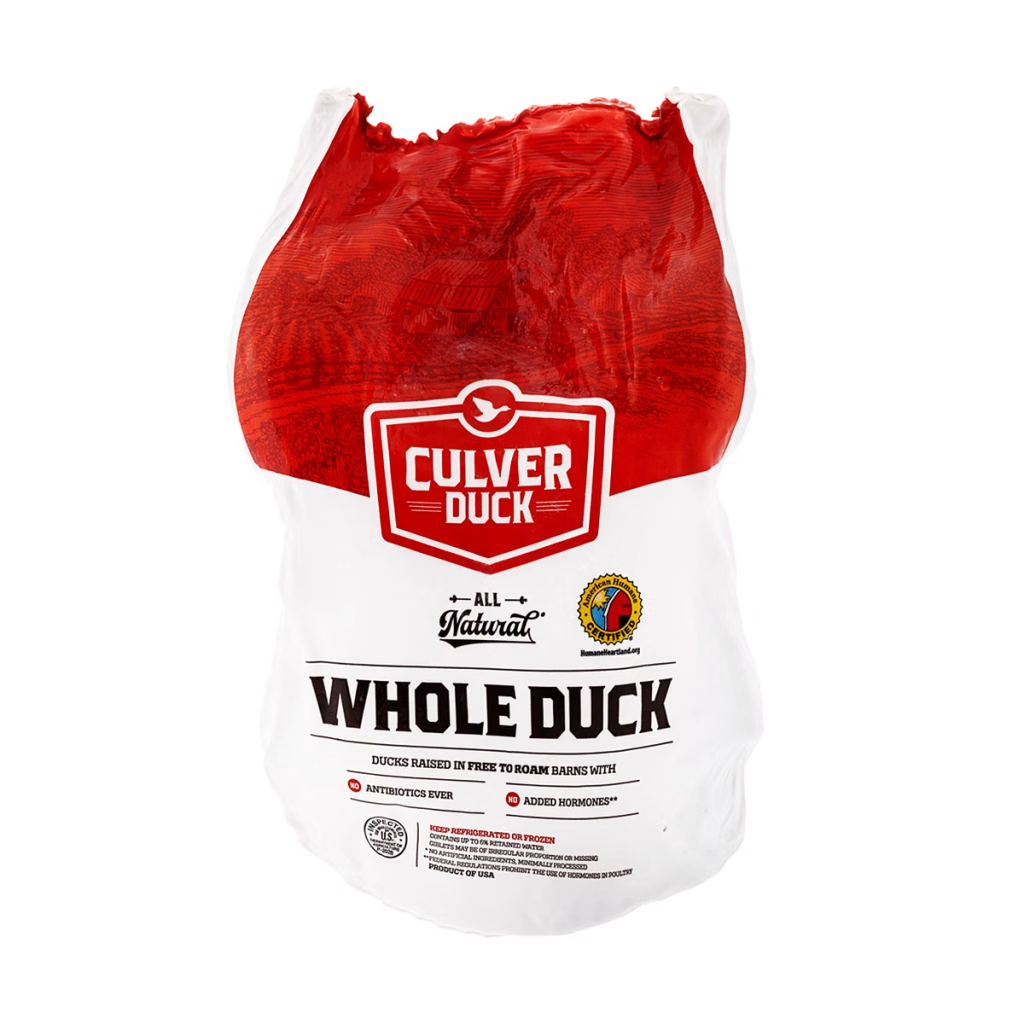
The ducks needed a couple of days to thaw in the refrigerator before we could brine them, so this is not quite an impulse-cooking project.
Unless you have access to fresh duck from a specialty butcher, farm or hunter, there’s a good chance the whole ducks you find will be frozen. That’s absolutely fine for this recipe. Just be sure to build thawing time into your plan.
Duck is naturally rich, so we wanted a brine that would season it all the way through while adding flavors that could stand up to the smoke.
The Grill-Meister did some research about duck brines and we came up with a recipe that combines salt and dark brown sugar with white wine, soy sauce, fresh oranges, peppercorns, bay leaves and ginger beer. We used peach-flavored ginger beer, because that’s what we had and because peach and duck sounded pretty darn good together.
The result isn’t overtly sweet or orangey. Those flavors stay in the background and become part of the overall seasoning.
Some recipes call for longer brining times, but we prefer about 12 hours; the smaller pieces, especially the legs, absorb the brine faster and can become too soft if left too long.


One very simple way to serve smoked duck is the way I had it in Bavaria last summer: cut in half and served with hearty side dishes. You can read more about that fabulous duck experience in Germany here: A First Bite of Bavaria: Smoked Duck, Red Cabbage and One Giant Potato Ball.
It was smoked duck and sausage gumbo that inspired us to try smoking ducks, but once those beauties came out of the smoker, it became obvious that we weren’t going to put all that glorious meat straight into a pot.
After the ducks cooled, we carved off a breast and crisped the skin in a skillet. That experiment worked so well that it became the next chapter in this little smoked-duck adventure.
A bit more of the duck gave us another dinner of flatbreads.
And then there was the gumbo.
OMG, the gumbo.
But I’m getting ahead of myself.
Next up: how we crisped and served the smoked duck later that night, including a sauce that began with the juices from the birds and a farmers’ market discovery.
©️ 2026, Glover Gardens

Yesterday was my birthday, but September 10 is also World Suicide Prevention Day. In memory of my brother Steve, I’m asking for one belated birthday gift: start the conversation.

A gift of fresh blue crabs at Gumbo Cove sent me into my vintage cookbook collection, where a family of creamy crab casseroles inspired this lemony Crab and Artichoke Casserole recipe. Along the way, I found patterns, party-food history and even more questions for Cooking the Past Forward.

Exploring old cookbooks, regional traditions and the stories, knowledge and hospitality behind the food
I have always loved old cookbooks.
That love was inherited.
My Mom collected more than 400 cookbooks, an enormous, wonderfully diverse collection that reflected her curiosity about food, people and places. She didn’t treat those books as sacred texts. She cooked from them, wrote in them, questioned them, adjusted them and made their recipes her own. She had a small kitchen by today’s standards, but she was a self-taught gourmet, driven to explore the cuisines of different cultures and learn about them, and from them.

I still find her handwriting in the margins of those books: additions, substitutions, judgments, reminders and the occasional emphatic instruction. Those notes are part of the recipes now, part of our family history, part of my heart. They reveal not only what she cooked, but how she thought.


But Mom gave me something even more valuable than the books themselves. She let me cook with her, starting when I was about 10 years old.
She taught me to pay attention to what a recipe was trying to accomplish. Sometimes that meant following it closely. Sometimes, with experience, it meant recognizing that a quantity, technique or combination needed interpretation or adjustment for the recipe to work.

I grew up participating in the kitchen rather than merely watching or simply eating what was served. Cooking was collaborative, exploratory, conversational and definitely fun. We tasted, adjusted, solved problems and created meals together. We experimented, innovated and laughed when something didn’t work.
Without ever explicitly saying she was teaching me, Mom made cooking a lived experience and a precious inheritance, along with her cookbooks. Much of what she passed on was never written down. I learned by watching, tasting, talking and doing.
Today I would call that tacit knowledge or tribal knowledge: the understanding held within a family or community that extends beyond written instructions. It includes how dark a roux should be, how a dish is supposed to feel, what belongs beside it on the table, when to make it and how to make the people eating it feel welcomed and cared for.
In that sense, Mom put me on this path long before I knew there was a path.
My parents eventually gathered many of our family recipes into their own cookbook, Great Tastes from the Texas Coast, along with contributions from friends, family and colleagues.

That book holds far more than instructions for preparing food. It contains the flavors of my childhood, the abundance of the Gulf, my parents’ personalities, the warmth and character of their galley kitchen in the beach house on stilts where I grew up, and the particular way our family and friends gathered around a table.
Recipes from it continue to surface throughout Glover Gardens: Mom’s marinated shrimp, my father’s chili, soft tacos like Mom made, party appetizers and a host of other dishes that have been cooked, remembered and adapted across decades.


Before Glover Gardens became a place for food, family, travel, gardens and memory, I decided to create a cookbook of my own. That impulse morphed into this blog, but there’s a cookbook in my future.
Now, after years of cooking, writing, collecting stories and, most importantly, being newly retired a bit early at just 62, I am devoting time to my cookbook collection with a larger purpose in mind.
What can old cookbooks teach us when we read not only the recipes, but everything around them? How can we carry that knowledge forward and use it to feed our families, welcome our friends and create meaningful experiences at our own tables?
I have come to think of this exploration as Cooking the Past Forward: understanding an old recipe, respecting its intentions and carrying its best qualities into a modern kitchen and onto today’s table.
I love old cookbooks because they contain so much more than instructions for preparing food. The recipes matter, but so do the voices, organizing choices, menus, ingredient patterns, cultural clues and family or community connections surrounding them.
A cookbook may tell us what people served at weddings, church suppers, holiday parties and family dinners. It may reveal which ingredients were abundant, which dishes were considered elegant, which foods appeared when a household needed to stretch what it had, and how restaurant cooking found its way into home kitchens.
It can also show us how people entertained. Sometimes the reader is being taught not just what to cook, but how to stage an experience. A complete menu may pair a seafood dish with a particular salad, bread, dessert, wine and coffee. A chapter title may describe not simply a meal, but a season, setting or social occasion.
The cookbook may be preserving an entire understanding of hospitality: how to welcome people, create a sense of abundance, delight them with something special and make a gathering feel complete.

Because eating together is such a meaningful communal experience, the recipes and the reminiscences are inseparable.
Vintage cookbooks are like campfire stories, only in writing. They form a bridge between food history, institutional history, community memory and inherited cooking knowledge.
All vintage cookbooks contain treasures that I can learn from, but the ones I find most intriguing are collective cookbooks, where a family or group has gathered recipes from its people and created a living history of what they cooked and ate.
A church, school, civic organization or family cookbook can preserve voices that might never have appeared in formal histories. It may capture domestic traditions alongside restaurant recipes and regional specialties beside fashionable dishes of the day, with contributions largely from women whose knowledge was shared through kitchens.
In a way, creating a community cookbook is an informal knowledge management project. A group recognizes that its members know valuable things, gathers part of that knowledge, organizes it and preserves it for others. The finished cookbook makes some of the community’s knowledge explicit, while leaving much of its tribal knowledge between the lines.
A recipe might say “make a dark roux,” “cook until done,” “season well” or “serve with egg sauce,” assuming that its original readers already understood exactly what those words meant. The written recipe is only part of the knowledge. The rest lived in experience, observation and shared community practice.
The original spark for this project was another kind of evidence: recipes that appear several times within the same cookbook. For instance, when a cookbook includes four versions of Daube Glacé or five Crawfish Étouffées, that is probably not simple editorial indecision. It suggests that the dish was so deeply woven into the community that no single family’s recipe could represent everyone else’s. Each version preserves a variation on a shared culinary theme.
Those repeated recipes are part of the culinary DNA of a place.
Absence can be revealing, too. Why, for example, does Corn Maque Choux appear less often than I expected in the Louisiana cookbooks I have examined so far? Perhaps it was so ordinary, intuitive and familiar that home cooks did not think it needed to be submitted. Everyone already knew how to make it, or learned by watching someone else.
That is only a working theory, but it is exactly the kind of question this project is beginning to uncover.
Community cookbooks offer evidence of how home and restaurant traditions were preserved, exchanged and adapted. They also show us what people believed about their food, how they described themselves, which stories they chose to preserve and whose contributions they recognized.
But they require thoughtful reading with a current lens.
Some older cookbooks make sweeping cultural claims, repeat stories that may be more legend than documented history, or reflect assumptions that belonged to their time but are no longer accepted as truth. Some contributors and culinary influences are celebrated, while others are minimized, generalized or unnamed.
That doesn’t make the books less valuable. It makes them more important to read carefully and to seek additional cookbooks from underrepresented populations and their potentially overlooked culinary traditions.
Sometimes what is absent from a cookbook is as revealing as what appears on the page. And what is there in triplicate, or more, or repeated across multiple publications, may be telling us that we have found something burrowed deep in the soul of the culture.

The first cookbooks I am exploring happen to focus heavily on Louisiana, New Orleans and the Gulf Coast. That is a natural starting place for me.
Mom and Dad loved New Orleans and took several memorable vacations there. Mom had more than three dozen cookbooks devoted to Louisiana’s diverse cuisine, from Paul Prudhomme to Justin Wilson to Emeril Lagasse, along with the vintage spiral- and plastic comb-bound community cookbooks that have inspired much of this project.
I grew up on the Texas Gulf Coast. Our family table was shaped by seafood, gardens, travel, curiosity and the mingling of cultures found all along the Gulf.
Gumbo, shrimp, crab, oysters, jambalaya, fish and boldly seasoned vegetables do not feel like distant culinary subjects to me. They are part of the landscape of my life, or perhaps I should say the seascape, given my days by the water.
Today, our days by the water happen at the bay camp on stilts we call Gumbo Cove in Bay St. Louis, Mississippi. We catch blue crabs in our own traps and cook them the same day, straight from the bayou.

I realized recently that this is a thing I can name: Bayou to table! More about that in a future post, my friends.
But this culinary research and cooking project will definitely not be limited to Louisiana cuisine. The larger starting point is the Gulf Coast and American South. My shelves include cookbooks from Galveston, Mississippi, Georgia and other parts of the region. Beyond them are vintage cookbooks from the Midwest, Southwest and many other communities and places. Each collection offers a new set of questions:
One of the clearest lessons emerging from the books I have been poring over is that regional cuisine has never been static.
Louisiana cooking itself grew through adaptation. French, Spanish, African, Indigenous, Caribbean, German, Italian and other influences met local seafood, game, rice, corn, vegetables, herbs and spices. Cooks substituted, combined and interpreted according to what was available and what tasted good.
Tradition is preserved not by setting it in stone, but by understanding how earlier cooks adapted intelligently and not being afraid to continue the evolution.
Translating the old into the new is not necessarily a departure from tradition. Done thoughtfully, it honors the tradition and may even become part of its continuing story when other people read, cook, taste and adapt the recipe again.
The important distinction is between informed adaptation and careless modernization. Tradition has boundaries, but within those boundaries there has always been variation.
A modern cook may need to reduce a recipe written for 60 people, clarify instructions that are arcane or assume knowledge we no longer possess, identify and replace an obsolete ingredient, or adjust a technique for today’s equipment.
We may choose fresher ingredients where a convenience product once represented progress. (I still remember the horrible gray mush of canned asparagus before fresh asparagus became readily available!) We may reduce excess fat or salt without stripping a dish of its character. Newer knowledge about food science may help us accomplish the recipe’s purpose more reliably.
But first, we should try to understand what the original recipe was intended to accomplish.
Sometimes I will make an old recipe almost exactly as written because that is the best way to learn from it. Other times, half a century of cooking experience (remember, I started early!) will tell me immediately that a quantity, technique or ingredient needs interpretation.
The goal is to understand the original recipe, respect its intentions and carry its best qualities into a modern kitchen and, more importantly, onto our tables today.
That feels true to the way Mom cooked. She paid attention, understood what mattered, imagined new possibilities and made thoughtful decisions. I have been treating recipes this way throughout my life because I learned it from her.
Understanding a recipe’s history is fascinating, but history for its own sake is not the destination of this project.
The larger question is how to translate that understanding into something useful, generous and delicious today.
How do I make this dish successfully in my own kitchen? How can I use it to feed my family? How might I serve it at a gathering so that people feel at home, cared for and delighted? What does knowing its history add to the experience of preparing and sharing it?
I don’t want these posts to offer only another internet recipe that can be replicated without context. I hope to help readers understand why a dish mattered, what knowledge it carries and how it can become meaningful in their own lives.
Knowing the story of a dish can change the way we approach it. It can give us confidence, pride and a sense that we are participating in something larger than one evening’s dinner.
My hope is not simply that you will make some of these recipes. It is that you will understand them well enough to make them your own, serve them with confidence and perhaps one day pass them to someone you love.
As I explore these books, I will also look for connections to recipes and stories already published here at Glover Gardens.
Sometimes I may discover that an old cookbook contains a recognizable ancestor of something I have been cooking independently for years.
Other times, I may begin with an old recipe intentionally, knowing that I want to study it, test it and translate it thoughtfully for today. That is what I did with my Peach & Pecan Coffee Cake.
I already knew I wanted to begin a more in-depth exploration of recipes in old cookbooks, although I had not yet organized the larger project or found the language to describe it. I selected a recipe, made it with close attention and adapted it as I worked, responding to the batter, the ingredients I had on hand, including peaches from the farmers market, and the result I wanted.
It became the first deliberate experiment in Cooking the Past Forward.
Those moments deserve to be noted, not as claims that every similar recipe descended directly from one source, but as opportunities to say:
Well, look at this. Someone came before me, working with similar ingredients or solving the same culinary problem, and there is something interesting here to notice.
The goal is to trace relationships, patterns and shared instincts across kitchens and generations, and to produce something tasty, memorable and worthy of repeating in your kitchen or mine.
I began by looking for dishes that appeared several times within a single cookbook because I suspected those repetitions revealed something important about the culture that produced it.
Then the questions expanded.
Why does one cookbook contain four Daube Glacé recipes? Why does another preserve at least five Crawfish Étouffées? Why does a Junior League cookbook from Acadiana devote an entire chapter to Mardi Gras and another to Comidas de Mexico? Why do restaurant dishes appear beside family recipes? Why is one everyday dish everywhere in lived experience but nearly invisible in the cookbooks?
I am beginning to realize that I am not only collecting recipes. I am collecting questions.
The spreadsheet I’m using to catalog the cookbooks has grown into something more like a culinary field notebook. It records repeated recipes, regional dishes, recipe prospects, unusual instructions, omissions, cultural clues, questions for further research and connections to my own family and Glover Gardens recipes.
It is part bibliography, part archive, part comparative analysis, part family memoir and part plan for future meals.
The cookbooks are already coming alive in a new way, and every answer seems to lead to another, better question.
I am not approaching these books primarily as a collector or cookbook recommender. I want to be a cuisine explorer, an amateur food historian, a careful reader of cookbooks and a respectful translator between past and present.
I will listen for the recipes that call out to be cooked, but I will also look for the patterns surrounding them:
Some recipes may be tested almost exactly as written. Some may need translation before they can even be tried. Some may inspire an entirely new Glover Gardens recipe. Others may never be cooked at all but may still reveal something worth sharing about a place, a time, a community or an evolving cuisine.


I hope it’s clear that I am neither putting the food of the past on a pedestal nor dismissing it as outdated or primitive. I am seeking to engage with it.
That means honoring the cooks who came before us without pretending their recipes are untouchable. It also means recognizing the social and historical context of the cookbooks while appreciating the creativity, skill and practical wisdom preserved within them.
I will think intentionally about what each recipe was and why before deciding how to carry it forward.
While I am fascinated by what vintage cookbooks tell us about kitchens, tables, cooks and eaters of the past, this is not nostalgia for its own sake. It is an effort to use the past to illuminate the future. The past should always illuminate the future, far beyond our kitchens and tables.
For 40 years, I had a rewarding corporate career, much of it devoted to knowledge management, collaboration, learning and helping organizations recognize, catalogue and share what their people knew.

I loved my career and look back on it with appreciation and pride. But workdays shaped by 7:00 a.m. meetings, full calendars, long commutes and quick weeknight dinners left limited room for following a question simply because it fascinated me.

Retirement has brought an unexpected and still slightly astonishing freedom. My time can now belong to curiosity in a way that it never has before.
Perhaps it is not surprising that my curiosity led me to a shelf of old cookbooks. I spent decades thinking about how knowledge is created, captured, shared and lost. Now I am asking many of the same questions about home cooks, families and communities.
This, too, is knowledge management, only the knowledge may be how to make a roux, feed 60 people, arrange a Mardi Gras supper or know when a dish is ready without needing a timer.
The domain has changed from organizations to kitchens. The purpose of honoring human knowledge and helping it live on has not. And my wardrobe has changed, too – no more suits! This is Retirement Me.

I began learning this kind of cooking beside Mom, long before I understood that recipes carry history. Now, surrounded by some of the books she loved, the cookbook my parents created and many others collected along the way, I am excited to learn where those histories will lead in the Glover Gardens kitchen and how they will enrich the pages of this blog.
The project has already begun with my Peach & Pecan Coffee Cake, and most recently, a dish I’m calling Gumbo Cove Crab and Artichoke Casserole (to be published soon).
Now the catalog is growing, the questions are taking shape and dozens of cookbooks are waiting their turn to be thumbed through. Their recipes will be studied, respected and perhaps reimagined.
I am thinking of this project as an ongoing conversation I’m having with the cookbooks, my kitchen and you, my readers. I will cook what calls to me, ask questions, follow the stories and share what I learn.
There will be oysters, crab, shrimp, gumbo and courtbouillon, joined by meat pies, game hens and bacon-laced everything. There will be corn, squash, peppers, cakes, casseroles, simple and sophisticated soups, forgotten party foods, molded salads, desserts and dishes I have never heard of.
Some recipes will work beautifully. Some will need rescuing. A few experiments will probably become epic failures, the kind that would have had Mom and me giggling uncontrollably. I will tell those stories, too, while weaving in what I learn about the families, institutions, communities, regions and cooks whose time in their own kitchens helped shape the food we know today.
I hope you will come along to discover with me. Perhaps you will make a few of the recipes, serve them to people you love and add your own experience to their continuing stories.


The recipes and reminiscences matter. The questions matter. The tables we create from them matter.
And the journey may be the most delicious part. See the growing list of posts, research and recipes here.
Let’s cook the past forward.
© 2026, Glover Gardens

Written for the August 29, 2026 celebration of Carl’s life, created using words and themes collected from numerous online remembrances from Carl’s family, friends, colleauges, customers, a chamber of commerce and his obituary. And our own Glover Gardens memories of our treasured friend.

Remembering our friend Carl Luning, known here as Carl the Roaster: a warm, funny, generous man who savored coffee, wine, food, music, family, friendship and every good story along the way.

Some posts are long, some posts are short.
Some are organic, some are responding to a prompt, and some are responding to external inspiration.
THIS post is a response to INTERNAL inspiration.
I have new peaches from the Hancock County Farmers Market (yay!) and I was searching the Glover Gardens blog for every mention of the word “peach”.
I found this post from 2017, a lovely experience when an esteemed colleague in another country, Anne, made one of my recipes and shared a picture with me.
Anne also shared a recipe for a summer cocktail, the one she enjoyed with the goat cheese salad recipe I had posted. It included peach schnapps, which is why it surfaced when I searched for the word “peach”.
SERENDIPITY! (My favorite word.)
I was happy to find this today because we are truly in the dog days of summer, and I know that cocktail will make its way into our Happy Cocktail routine before long.
Today, we are at Gumbo Cove, and had different cocktails: a Paper Plane for me, and an Old Fashioned for The Grill-Meister.

Suffice it to say that I will share our versions of the Paper Plane and Old Fashioned soon.
But finding that old post brought back much more than a cocktail recipe. It brought back memories of Anne, and of the years we spent together as colleagues and friends.
So I’d like to share a few more pictures of the lovely Anne, my Scottish friend.


Colleagues come and go in a long career, like cocktails come and go in your tastes.
But some, you remember, and cherish.
Anne is one of them. And I will toast her when we make the Summer Days cocktail again soon.
© 2026, Glover Gardens

Old Bay may be tasty, but does a Baltimore-born seasoning really belong in the Southern Food Hall of Fame? A playful challenge, plus a worthy Texas Gulf Coast contender: homemade Zippy Cajun.

These crispy, lacy potato pancakes are golden at the edges, tender inside and threaded with fresh parsley. Inspired by Jacques Pépin’s mother’s recipe and adapted the Glover Gardens way, they are made easier with a food processor and are just right with weisswurst, barbecue, brunch or a dollop of sour cream.


I have cousins in ministry, and this is a guest post from two of them, Steven and Rachel Harvell.

Here’s a call for submissions for original work about mental health, to be published in an anthology.
At Glover Gardens, we are seriously into plants and gardening, each of us having been raised by folks who were, well, seriously into plants and gardening. A reader of one of my blog posts left this link for me to check out; it has a…

This little boy just stole my heart with his recipe and his sincerity


